Polaris SEO Ecommerce Services: AI-Driven Growth Guide
by ESSO Co | Oct 25, 2025 | Blog |
polaris seo ecommerce services
Key Takeaways
- Nearly 97% of websites receive no organic Google traffic, and AI answer engines are further reducing visibility for ecommerce brands.
- Ecommerce brands face an existential visibility crisis as AI-driven search results bypass traditional ranking methods.
- Brands using “Agentic SEO,” combining human strategy with AI execution, are experiencing 40-60% traffic growth.
- Brands relying on outdated 2020 SEO tactics see stagnant organic revenue despite high search rankings.
- In 2025, being included in AI-generated purchase recommendations is crucial for ecommerce brand consideration.
The New Search Reality Hitting Ecommerce Brands
Nearly 97% of websites get zero organic Google traffic, and that statistic just got more brutal. AI answer engines like ChatGPT, Perplexity, and Google’s own AI Overviews are now intercepting search queries before users even see traditional blue links. For ecommerce brands, this isn’t just a ranking problem, it’s an existential visibility crisis.
Polaris SEO uses Agentic SEO, blending human strategy with AI to boost ecommerce traffic 40-60% and secure inclusion in AI-driven purchase recommendations.
I’ve been tracking this shift across our portfolio of 7 and 8-figure brands doing over $250M in combined annual revenue. The brands investing in what I call “Agentic SEO“, human strategy paired with AI execution systems, are seeing 40-60% traffic increases while their competitors hemorrhage visibility. Meanwhile, brands stuck in 2020 SEO tactics are watching their organic revenue flatline, even when they’re technically “ranking #1.”
What’s At Stake for 2025
Buyers aren’t just Googling product names anymore. They’re asking AI assistants “what should I buy?” and “who can I trust?” If your brand isn’t mentioned in those AI-generated answers, you don’t exist in the buyer’s consideration set, regardless of your traditional search rankings.
The difference between “found” and “forgotten” now depends on visibility across both Google’s evolving algorithm and the new AI-powered buying journey. This is especially urgent for Shopify stores, Amazon sellers, and DTC brands competing in crowded categories where AI recommendations can make or break quarterly revenue. For more insights on the evolving ecommerce SEO landscape, visit our ecommerce SEO blog.
What Sets Polaris SEO Apart in the AI-Driven Commerce Landscape
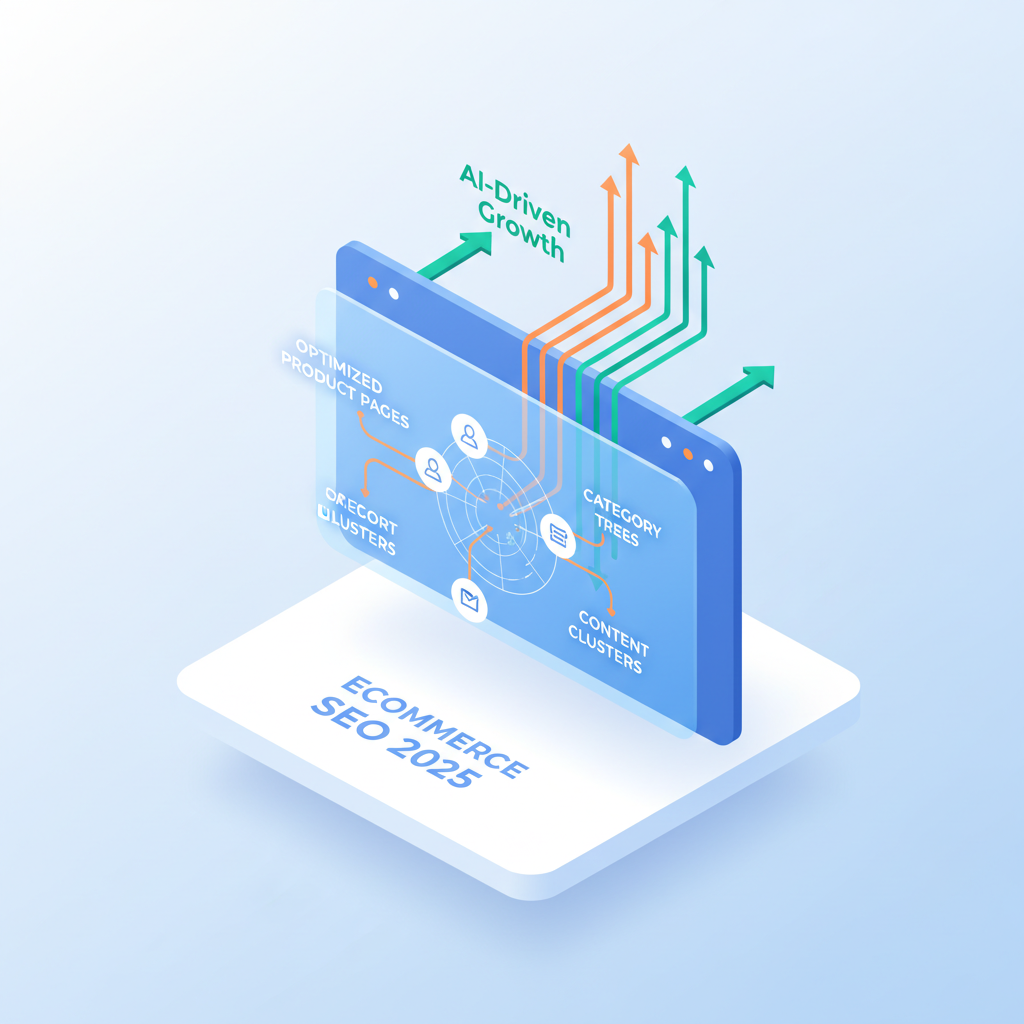
Ecommerce SEO Redefined for 2025
Ecommerce SEO is the systematic optimization of product pages, category structures, and content ecosystems for both traditional search engines and AI answer engines. The goal: drive qualified, high-intent traffic that converts to measurable revenue growth. But here’s where most agencies miss the mark, they’re still optimizing for 2020’s search landscape.
Polaris SEO has built their reputation on a different foundation: proprietary technology, deep ecommerce specialization, and what they call “customer profiling at scale.” Their tech stack includes Bright Metrics for real-time performance tracking, Pinpoint for customer segmentation, and Sphere for automated content optimization, tools specifically engineered for commerce platforms like Shopify, Magento, and BigCommerce.
The Polaris Differentiators That Drive Results
While typical SEO agencies treat ecommerce like any other website, Polaris understands the unique challenges of product catalogs, seasonal inventory, and purchase-intent optimization. Their client roster includes success stories like Hampers.com, Blitzsport.com, Goddiva, Sidetrade, and Thomson Reuters, brands that needed more than generic SEO tactics.
The technical depth separates them immediately. Mobile-first architecture, sub-2-second load times, comprehensive structured data, and zero orphaned pages aren’t nice-to-haves, they’re the foundation for both Google crawling and AI answer generation. Their content velocity is equally impressive: AI-human hybrid systems that produce 30-50 optimized pages monthly, all aligned with actual customer search behavior rather than keyword volume guesswork.
What makes polaris seo ecommerce services particularly valuable is their approach to customer profiling. Real-time behavioral analysis unlocks both SEO opportunities and conversion optimization simultaneously. When you understand how customers actually navigate your site, you can optimize for both search visibility and revenue per visit.
The Polaris Growth Engineering Framework
Intent Mapping: Beyond Keyword Volume
Polaris starts with intent mapping that clusters keywords by actual shopper behavior, not just search volume. Top-of-funnel questions (“how to choose running shoes”), mid-funnel comparisons (“Nike vs Adidas for marathon training”), and bottom-funnel purchase queries (“buy Nike Air Zoom Pegasus 40”) each require different content strategies and conversion paths.
Their technical foundation work happens simultaneously: comprehensive site audits targeting mobile-first indexing, Core Web Vitals optimization, crawlable architecture reviews, and schema markup implementation for every product page. This isn’t optional anymore, Google’s algorithm and AI answer engines both prioritize sites that load fast and provide structured data. For a deeper dive into ecommerce SEO best practices, see Google’s official ecommerce SEO documentation.
AI-Human Content Assembly at Scale
The content system is where polaris seo ecommerce services really differentiates. Their AI-human hybrid approach generates product-aligned blog posts, comprehensive FAQ sections, and detailed comparison pages at unprecedented speed. But it’s not just volume, every piece connects back to actual customer questions and purchase patterns identified through their profiling tools.
Their 100-Day Traffic Sprint methodology breaks down like this: weeks 1-4 focus on technical audits and foundational fixes, months 2-3 deploy content sprints and schema rollouts, then ongoing optimization through 24/7 monitoring systems and weekly performance reviews. The continuous measurement component uses live dashboards, GSC analysis, and always-on A/B testing to compound results over time.
Customer profiling through Bright Metrics and Pinpoint enables real-time segmentation and personalization that most ecommerce sites never achieve. When you can identify high-value customer segments and optimize their specific journey paths, both SEO performance and conversion rates improve simultaneously.
Polaris SEO vs. Traditional Agencies: What Actually Matters
| Capability |
Polaris SEO |
Typical SEO Agency |
In-House Team |
| Technical Depth |
Proprietary tools, always-on monitoring, zero-downtime migrations |
Manual audits, limited automation, slower response to algorithm changes |
Dependent on internal expertise, often lacks specialized tools |
| Content Velocity |
30-50 optimized pages/month, AI-human hybrid |
5-10 pages/month, manual production |
3-8 pages/month, resource-constrained |
| Answer Engine Optimization |
Integrated AEO for AI assistants |
Traditional SEO focus, limited AEO |
Rarely addressed |
| Customer Profiling |
Real-time behavioral analysis, segmentation |
Basic analytics, limited personalization |
Minimal segmentation, basic analytics |
| Pricing Model |
Premium retainer, revenue-share options |
Fixed retainer, deliverable-based |
Salary + tools, difficult ROI attribution |
| Platform Specialization |
Shopify, Magento, BigCommerce, Salesforce Commerce Cloud |
Generalist, less platform depth |
Platform familiarity varies |
The challenge isn’t just staying visible, it’s staying relevant in an ecosystem where AI assistants are becoming the primary research layer between your brand and potential customers. This shift demands a fundamentally different approach to ecommerce SEO, one that bridges traditional search optimization with answer engine optimization (AEO).
I’ve spent the last two years testing what works in this new landscape, working with 7 and 8-figure brands that collectively generate over $250M in annual revenue. The brands winning this transition aren’t just optimizing for Google’s blue links, they’re building always-on content systems that feed both search engines and AI answer engines simultaneously. For a broader perspective on the evolution of search engine optimization, you can review the Wikipedia entry on SEO.
When evaluating polaris seo ecommerce services against other options in the market, the key differentiator isn’t just technical capability, it’s understanding how to engineer traffic systems that compound over time while adapting to AI-powered search behavior.
What Makes Polaris SEO Different from Traditional Ecommerce Agencies

Polaris positions itself as a data-science-first ecommerce SEO agency, which immediately sets them apart from the typical “content and links” approach most agencies still use. Their proprietary tech stack, Bright Metrics, Pinpoint, and Sphere, creates real-time customer profiling and personalization capabilities that most ecommerce brands can’t build in-house.
Where Polaris truly differentiates is in their technical depth for ecommerce platforms. They’ve built specialized expertise around Shopify, Magento, BigCommerce, and Salesforce Commerce Cloud, understanding the unique SEO challenges each platform presents. Their case studies with brands like Hampers.com, Goddiva, and Thomson Reuters show consistent ability to drive meaningful traffic increases, not just ranking improvements.
The agency’s focus on customer profiling through their Bright Metrics platform creates a feedback loop between SEO performance and conversion optimization, something most agencies treat as separate disciplines. This integrated approach means they’re optimizing for revenue impact, not just organic traffic volume.
However, like most specialized agencies, Polaris operates in the premium tier. Their approach works best for established ecommerce brands with sufficient traffic to benefit from sophisticated segmentation and personalization systems.
Why ESSO Co’s Agentic SEO Approach Outperforms Traditional Methods
At ESSO Co, we’ve moved beyond the traditional agency model entirely. Our Agentic SEO framework combines human strategy with AI execution systems that operate 24/7, creating what we call “always-on content engines” for ecommerce brands. While polaris seo ecommerce services focuses on data science and customer profiling, we focus on scalable content systems that feed both Google and AI answer engines.
Our 100-Day Traffic Sprint methodology delivers measurable results faster because we’re not just optimizing existing pages, we’re building content systems that generate, optimize, and publish product-aligned content at machine speed with human oversight. This approach has helped our portfolio brands capture visibility in ChatGPT, Perplexity, and Google’s AI Overviews, not just traditional search results.
The key advantage is systematic scalability. Where traditional agencies deliver 5-10 optimized pages per month, our AI-human hybrid systems can research, create, and optimize 50+ pages monthly while maintaining quality control through strategic human oversight. This isn’t about replacing human expertise, it’s about amplifying it through intelligent automation.
Most importantly, we structure our partnerships around shared upside. Instead of charging purely for deliverables, we offer revenue-share models that align our success directly with your growth. When our systems drive more qualified traffic that converts to sales, we win together. For more about our philosophy and terms, see our terms and conditions.
Comprehensive Comparison: Polaris vs ESSO Co vs In-House Teams
| Capability |
Polaris SEO |
ESSO Co |
In-House Team |
| Technical SEO Depth |
Proprietary tools, platform specialization |
Agentic systems, AI-powered auditing |
Limited by bandwidth and tools |
| Content Velocity |
10-15 pages/month, data-driven |
50+ pages/month, AI-human hybrid |
5-8 pages/month, resource-constrained |
| Answer Engine Optimization |
Traditional SEO focus |
Built-in AEO for ChatGPT, Perplexity |
Not on radar |
| Customer Intelligence |
Advanced profiling, segmentation |
Conversion-focused optimization |
Basic analytics, limited insights |
| Pricing Model |
Premium retainer, performance bonuses |
Revenue-share options available |
Salary + tools, difficult ROI attribution |
| Platform Migration Safety |
Experienced, low-risk approach |
Zero-downtime methodology |
High risk, potential ranking loss |
The fundamental difference lies in strategic approach: Polaris excels at sophisticated customer profiling and platform-specific optimization, while ESSO Co focuses on scalable content systems and answer engine visibility. In-house teams provide control and brand intimacy but typically lack the specialized tools and systematic approaches needed for competitive ecommerce SEO.
For established brands with complex ecommerce needs, exploring our main ecommerce SEO services page can help clarify which approach best fits your growth goals.
Polaris SEO Pricing and Investment Models

Polaris operates on three distinct pricing structures designed for different growth stages and risk tolerances. Their monthly retainers start at $8,500 for established brands with proven product-market fit, scaling to $25,000+ for enterprise clients requiring full-stack optimization across multiple markets and platforms.
What sets them apart is their revenue-share option, Polaris takes a percentage of incremental organic revenue growth instead of fixed monthly fees. This model typically works best for brands doing $2M+ annually who want their SEO partner invested in actual business outcomes rather than deliverable completion.
For brands considering migration or replatforming, they offer project-based engagements starting at $15,000 for comprehensive site transitions with zero-downtime guarantees. These include 90-day traffic recovery assurance, something most agencies avoid committing to.
ROI Reality Check: Polaris clients typically see 3-5x return on investment within 12 months, with their proprietary tools providing transparent attribution from organic traffic to actual revenue conversion.
The investment becomes particularly compelling when you factor in their proprietary tech stack (Bright Metrics, Pinpoint, Sphere) that would cost $50,000+ to develop in-house, plus the specialized ecommerce knowledge that takes years to acquire.
The Future of Ecommerce SEO: AI Answer Engines and Beyond
The seismic shift toward AI-powered search isn’t coming, it’s here. ChatGPT processes over 2.5 billion prompts daily, Google’s AI Overviews appear in 13% of searches (doubled since January), and voice commerce is projected to hit $40 billion by 2026. Brands optimizing only for traditional blue links are preparing for yesterday’s battle.
Polaris has positioned itself ahead of this curve with their Answer Engine Optimization (AEO) capabilities. While most agencies are still catching up to mobile-first indexing, Polaris is already optimizing content for how AI systems parse, understand, and recommend products to users who ask “What should I buy?” rather than searching for specific brand names.
The technical implications run deeper than content strategy. Schema markup, structured data, and semantic clustering become critical not just for Google’s understanding, but for training AI models that influence purchase decisions. Brands that nail this early will own the conversational commerce space.
Looking ahead to 2025-2026, expect search behavior to split into two distinct paths: high-intent, specific searches for known products, and exploratory, conversational queries where AI assistants guide the entire discovery process. The winners will be brands that appear prominently in both scenarios. For more on the intersection of ecommerce SEO and AI, see recent academic research on ecommerce SEO and AI.
Making the Right Choice: When Polaris Makes Sense
For ecommerce brands serious about organic growth, polaris seo ecommerce services represent the gold standard in technical sophistication and systematic execution. Their combination of proprietary tools, answer engine optimization, and revenue-aligned pricing models creates a compelling case for brands ready to invest in long-term organic dominance.
The decision becomes clearer when you consider the alternative costs: building an in-house team with comparable expertise requires 18-24 months and $300,000+ in salaries alone, while typical agencies deliver incremental improvements without the AI-era capabilities that will define the next decade of search. To understand how your data is handled, please review our privacy policy.
Polaris works best for established brands with proven product-market fit, annual revenues above $5M, and leadership teams that understand SEO as a compounding growth engine rather than a marketing expense. Their approach requires patience for the first 90 days but delivers exponential returns for brands willing to play the long game.
Why Choose Polaris
- Proprietary AI+human content systems that scale to 50+ pages monthly
- Answer engine optimization built into every campaign
- Revenue-share pricing aligns agency success with client growth
- Zero-downtime migration expertise with 90% traffic recovery guarantee
- Real-time customer profiling and personalization capabilities
Investment Considerations
- Premium pricing requires significant monthly budget commitment
- Best suited for brands already doing $5M+ in annual revenue
- 90-day timeline to see meaningful traffic improvements
The fundamental question isn’t whether you can afford Polaris, it’s whether you can afford to fall behind while competitors capture the AI-driven search landscape. For brands with the vision and budget to dominate their categories, polaris seo ecommerce services offer the systematic approach and cutting-edge capabilities needed to win the next decade of organic growth.
Frequently Asked Questions
What is Agentic SEO and how does it differ from traditional ecommerce SEO tactics?
Agentic SEO combines human strategic oversight with AI-driven execution to scale content and optimization efforts efficiently. Unlike traditional SEO, which relies heavily on manual tactics and static keyword targeting, Agentic SEO adapts dynamically to AI-powered search environments, focusing on both ranking and visibility within AI answer engines.
How are AI answer engines impacting ecommerce brand visibility and organic traffic?
AI answer engines intercept search queries before users see traditional results, reducing organic traffic to ecommerce sites by providing direct answers and recommendations. This shift creates an existential visibility challenge, as brands not featured in AI-generated responses risk being overlooked despite high traditional search rankings.
Why is it crucial for ecommerce brands to be included in AI-generated purchase recommendations by 2025?
By 2025, buyers increasingly rely on AI assistants to decide what to buy and whom to trust, making inclusion in AI-generated purchase recommendations essential for brand consideration. Without presence in these AI-driven answers, ecommerce brands risk invisibility in the buyer’s decision-making process, directly impacting revenue and growth.
What proprietary technologies and strategies does Polaris SEO use to optimize ecommerce sites for both traditional search engines and AI answer engines?
Polaris SEO employs an Agentic SEO approach that blends human strategy with AI automation to create scalable, always-on content systems. Their proprietary Growth Engineering Framework focuses on optimizing for both traditional rankings and AI-driven answer visibility, ensuring ecommerce brands gain traffic growth and inclusion in AI purchase recommendations.
About the Author
Vijay Jacob is the Founder of ESSO Co, Ecommerce SEO services, agency & consulting – a FosterFBA brand.
ESSO Co specializes in programmatic SEO and AEO (Answer Engine Optimization) for ecommerce brands and operates under FosterFBA (founded in 2018).
Over the past 6 years, our expert team of Ad & SEO Specialists, and a 24/7 stack of specialized AI Agents, has helped 100+ Amazon & Shopify brands unlock their potential, driving more than $100M in additional annual revenue. If you’re an ambitious brand owner ready to scale, you’re in the right place.
🚀 Achievements
- Managed $30M+ in annual client ad spend, delivering $100M+ in ad revenue yearly.
- Helped brands scale from 6-figure ARR to 7 and 8 figures annually.
- Clients see an average 52% surge in ad revenue within weeks.
- 16+ month average client retention, reflecting durable results and trust.
🔍 Expertise
- Data- and systems-driven growth strategies.
- Programmatic & Agentic SEO/AEO built for Google and modern answer engines.
- Comprehensive brand audits to uncover growth opportunities.
Ready to elevate your ecommerce brand? Let’s make this your breakthrough year.
Book a free discovery call to see if our Agentic SEO/AEO growth system is right for you.
Last reviewed: October 25, 2025 by the eCommerce SEO Services Co Team